

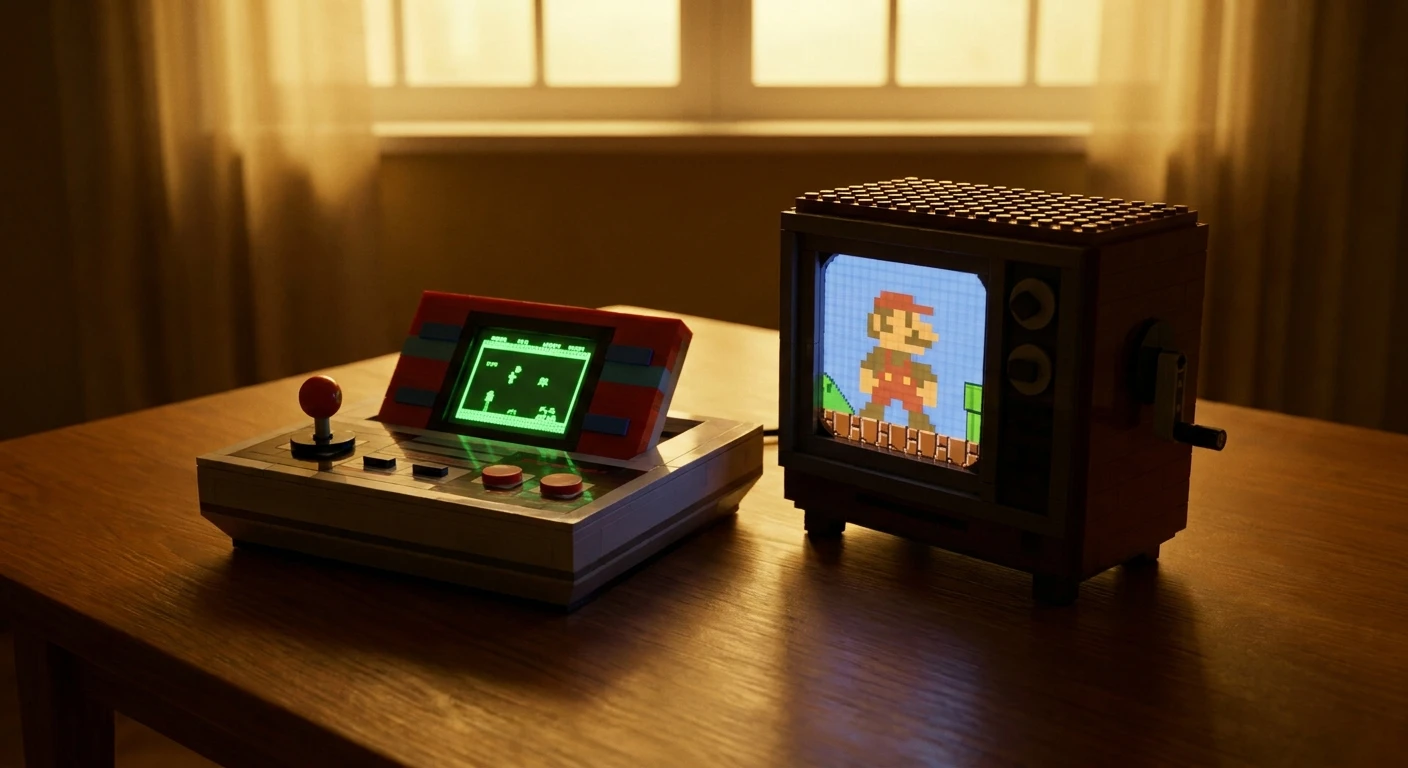
Reliving the 8-Bit Glory Days with the LEGO NES
If you want to physically construct a masterpiece of video game history, the LEGO NES is an absolute marvel of toy engineering. You know that specific, satisfying click when you pushed a chunky grey game cartridge into your Nintendo Entertainment System back in the 1980s? Replicating that exact tactile sensation using plastic building blocks sounds completely absurd, yet this specific model pulls it off flawlessly. Putting this massive kit together feels like stepping into a time machine, taking you straight back to Saturday mornings spent sitting cross-legged in front of a glowing television screen.
This massive kit perfectly captures the nostalgic aesthetics of the original console while introducing an interactive mechanical television that brings the classic pixelated levels to life right before your eyes. You are not just clicking basic bricks together; you are assembling a highly complex mechanical diorama. From the satisfyingly springy buttons on the life-sized controller to the hidden easter eggs tucked away inside the console’s chassis, every single bag of parts offers a new surprise. Whether you grew up blowing into dusty cartridges or you simply appreciate master-level brick engineering, the build process offers an incredibly therapeutic and rewarding experience that bridges the gap between digital entertainment and physical artistry.
Read also: Ultimate Pokémon LEGO Sets and Building Guide; Xbox Ally X: The Ultimate Handheld Console Guide.
When you open the massive, premium black box, you immediately realize you are dealing with a top-tier adult collectible. The sheer volume of bags indicates that you are about to embark on a multi-day construction journey. This model serves two massive purposes. First, it acts as the ultimate centerpiece for a retro gaming room, sparking instant conversations the second anyone walks in and sees it sitting on your shelf. Second, it provides a hands-on masterclass in mechanical engineering for building enthusiasts, showing exactly how rotary motion can be translated into linear scrolling action.
| Component | Complexity Level | Interactive Feature |
|---|---|---|
| NES Console | High (Technic Integration) | Opening cartridge slot with locking mechanism |
| Retro CRT Television | Very High (Moving Parts) | Side-scrolling mechanical screen |
| Controller & Cartridge | Low (Standard System Bricks) | Pressable rubber-membrane style buttons |
To truly appreciate the value of this massive undertaking, you need to break down the construction into its core phases:
- Constructing the Console Chassis: You begin by framing the iconic two-toned grey box, carefully aligning the internal spring-loaded tray that will eventually hold the buildable game cartridge.
- Engineering the Television Mechanism: This is where you assemble a complex internal treadmill using flexible tracks, mounting tiny plates that represent pipes, Goombas, and brick blocks.
- Assembling the Peripherals: Building the controller with its pluggable cord and constructing the incredibly accurate game cartridge completes the physical illusion.
Every single step of this process is meticulously designed to prevent frustration while keeping the challenge level high enough to remain engaging.
Origins of the Nintendo and LEGO Partnership
Think about how fiercely protective Nintendo is with their intellectual property. For decades, the idea of an official brick-built Nintendo product was nothing more than a pipe dream for fans. The collaboration finally kicked off with the interactive electronic figures, which were heavily geared toward younger children. However, the designers knew that millions of adult fans desperately wanted something geared toward a mature aesthetic. The conceptualization of a full-scale replica console was the perfect bridge. It allowed the designers in Billund to flex their creative muscles while paying deep respect to the hardware that essentially saved the home video game market after the crash of 1983.
Evolution of the Design Process
Scaling the classic console down slightly while keeping the iconic proportions was a massive hurdle for the design team. The original grey plastic of the 1985 hardware has a very specific texture and color palette. Translating those smooth surfaces into studded blocks required the creation of several new printed elements. Furthermore, the team faced the daunting task of designing a retro CRT television that was proportional to the console, while ensuring it had enough internal hollow space to house a complex scrolling belt. Early prototypes were reportedly incredibly fragile, requiring constant reinforcement using internal scaffolding to ensure the final product wouldn’t buckle when the user turned the television crank.
Modern State of Retro Collectibles
The market for retro merchandise has shifted dramatically over the past decade. We have moved way beyond simple plastic keychains and basic graphic t-shirts. Adult collectors now demand premium, highly detailed display pieces that reflect their passions. This massive build perfectly encapsulates that shift. It sits proudly next to high-end vinyl figures and premium art books. It proves that there is a massive appetite for physical, tactile products that celebrate digital history, elevating gaming merchandise into the realm of interactive kinetic art.
The Mechanics Behind the Scrolling Screen
The true magic of this set happens behind the thick, curved glass-like panel of the retro CRT TV. You are basically building a miniaturized industrial treadmill. The side crank turns a series of internal gears that rotate a continuous flexible track. The 8-bit character figure is mounted on a clear, rigid stick that sits on a smooth track just above the scrolling background. As you turn the handle, the textured plates on the treadmill push the stick up and down, making the character appear to organically jump over green pipes and stomp on enemies. It is a brilliant optical illusion powered entirely by manual kinetic energy.
Cartridge Slot Engineering
Replicating the original zero-insertion force (ZIF) socket using standard plastic elements is arguably the most impressive feat in the entire box. When you slide the brick-built cartridge into the chamber and press it down, a specialized rubber shock absorber and a series of tension springs catch the tray, locking it into place with an audible click. Pressing it again releases the tension, popping the cartridge back up.
- Gear ratios: The crank handle utilizes specific gear reduction techniques to ensure smooth, continuous scrolling without catching or snapping the delicate internal treads.
- Friction tolerances: The cartridge tray mechanism relies on rubber elements to create just enough friction to hold the weight of the cartridge without permanently stressing the plastic.
- Structural integrity: The entire television casing relies on rigid beams intersecting with standard system bricks to prevent the walls from bowing outward under the tension of the moving belt.
Optimal Display Environments
Once you finish this massive project, you need to find the perfect place to show it off. Treat this piece like a delicate museum artifact. Keep it strictly out of direct sunlight. The specific grey plastic elements used in this model are highly susceptible to UV degradation, meaning they will turn a nasty, brittle yellow if left near a bright window—ironically, this is the exact same problem that plagued the actual hardware from the 1980s. A dedicated gaming shelf with soft, ambient LED lighting is the absolute best environment to highlight the texture of the bricks without causing long-term damage.
Maintenance and Dusting Techniques
Because of all the exposed studs, especially on the top of the console and the textured screen of the television, this model is an absolute dust magnet. Never use wet cloths or harsh chemical sprays to clean it. Instead, pick up a set of soft-bristled makeup brushes. These brushes are gentle enough to sweep dust out from between the tiny crevices of the controller buttons and the television dials without accidentally knocking small cosmetic tiles loose. For the internal mechanism of the TV, a quick burst of compressed air every few months will keep the gears turning smoothly without grinding dust into the moving axles.
Integration with Electronic Figures
If you own the electronic interactive figures from the starter courses, you can seamlessly integrate them into this display. There is a specially designed slot hidden underneath a removable plate on top of the retro television. When you place the electronic figure into this slot and turn the crank, a hidden barcode reader scans colored tiles passing by on an internal wheel. The figure will then play the classic overworld theme music and emit authentic sound effects perfectly timed to the actions happening on the scrolling screen below.
Customization Ideas
The beauty of this system is that you are not locked into the default design. Many creative builders have ordered extra blue, brown, and green plates to completely rebuild the scrolling television belt. Instead of the default daytime overworld level, you can meticulously recreate the dark, brick-heavy underground sections, or even the watery depths of the swimming levels. Since the internal mechanism relies on standard connection points, your ability to customize the screen is limited only by your imagination and your inventory of spare parts.
Myth: The completed model can play actual vintage game cartridges.
Reality: The console is constructed entirely out of solid plastic building elements and contains absolutely zero electronic components, motherboards, or pins required to read actual vintage game data.
Myth: The scrolling television screen requires AA batteries or a wall plug to operate.
Reality: The screen operates purely on mechanical kinetic energy provided by physically turning the side crank, utilizing gears and treads rather than electric motors.
Myth: You need to be a master builder with decades of experience to successfully assemble this kit.
Reality: While the piece count is massive, the incredibly detailed instruction manuals break the process down into highly manageable, numbered bags that are perfectly suitable for patient beginners who are willing to follow instructions closely.
How many pieces are included in the box?
The entire package contains precisely 2,646 pieces, divided between the console, the controller, the game cartridge, and the mechanical television.
Does the controller actually plug into the console?
Yes, the controller features a flexible rubber cord that plugs directly into a specialized port on the front of the brick-built console.
Can you purchase the retro television separately?
No, the console and the television are packaged together as one unified, comprehensive building experience and cannot be bought independently.
Are the buttons on the controller functional?
While they do not send electronic signals, the directional pad and the red A and B buttons utilize rubber elements to provide a satisfying, pressable tactile feedback.
How long does the entire construction process take?
Depending on your experience level and sorting speed, you should expect to spend roughly eight to twelve hours completing the entire project.
Does the package include the electronic character figure?
No, the interactive electronic figure required for the music and sound effects must be purchased separately via the standard starter course sets.
What are the dimensions of the finished television?
The completed television measures over 8 inches high, 9 inches wide, and 6 inches deep, making it a substantial display piece.
Is the brick-built cartridge true to scale?
Yes, the buildable cartridge is remarkably close to a 1:1 scale representation of the original grey plastic media.
Building the LEGO NES is an incredibly rewarding journey through the golden age of 8-bit gaming. It offers a flawless blend of nostalgic reverence and cutting-edge mechanical toy design. From the brilliant tension of the cartridge slot to the mesmerizing rotation of the television screen, every single step of the process reminds you why you fell in love with gaming in the first place. Clear off your dining room table, grab your bags of bricks, and start building your own tangible slice of video game history today!





Leave a Reply