

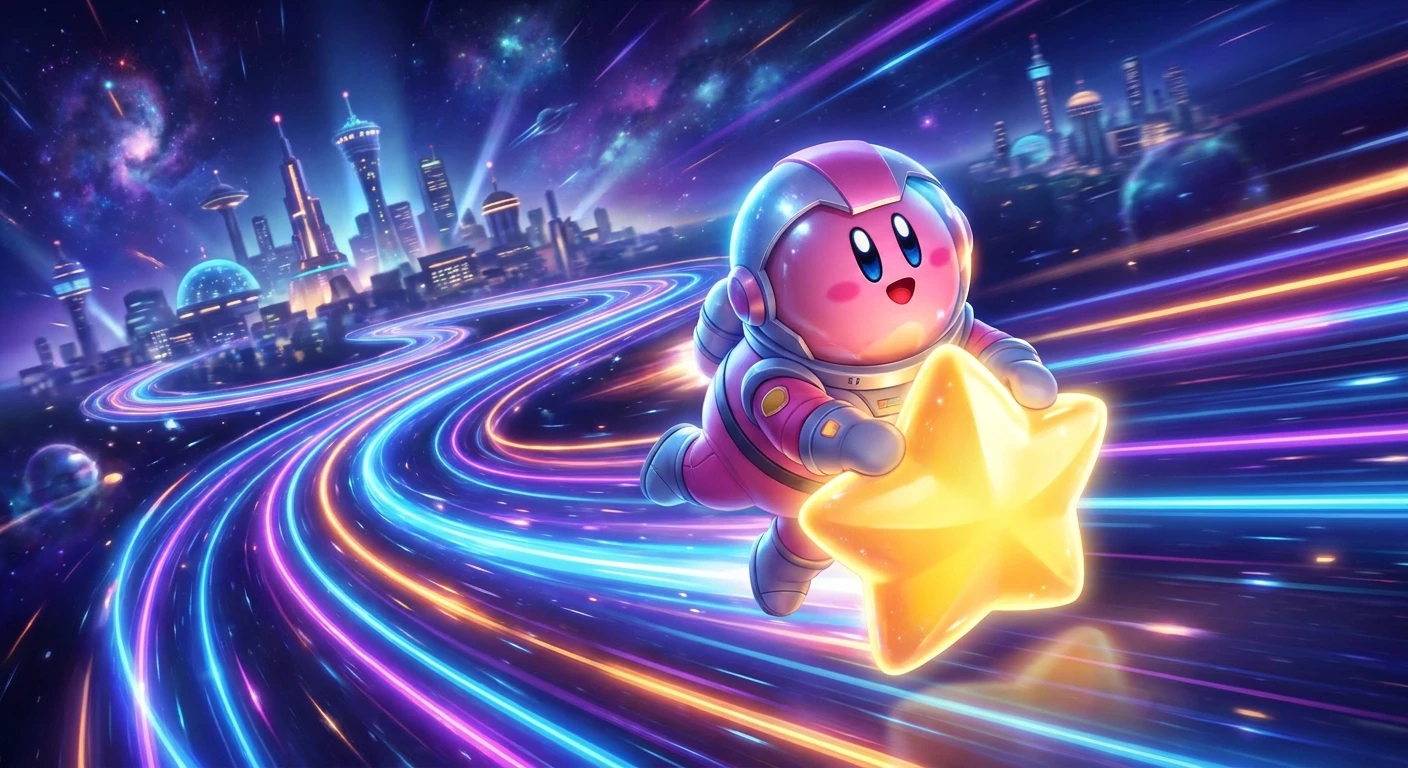
Kirby Air Riders: Racing Through the Cosmos
Hey everyone, ever find yourself nostalgic for that one incredibly unique racing game from the GameCube era? If you are talking about Kirby Air Riders, you are exactly where you need to be. This particular game completely broke the mold of traditional kart racers when it launched, and it remains an absolute masterclass in minimalist design. Unlike standard track games that require you to memorize complex shifting patterns and multi-button drifting mechanics, this title uses a remarkably simplified control scheme. It relies almost entirely on just one single action button paired with the analog stick. Despite being over two decades old, the community surrounding this masterpiece remains vibrant, highly competitive, and constantly active in finding new ways to push the physics engine to its absolute limits. From the high-speed, unpredictable chaos of the standard racing mode to the top-down strategic depth of the miniature tracks, and of course, the completely open-ended playground of the city exploration mode, the sheer variety packed onto this tiny disc is phenomenal. Whether you are a veteran speedrunner looking to shave precious milliseconds off your personal bests, or a casual player just wanting to cruise around a colorful, vibrant universe with friends on a weekend, understanding the hidden mechanics of these celestial machines gives you a massive, undeniable advantage on the track.
Let us talk about the core appeal and what makes this game tick so beautifully. The value proposition of this classic racer lies in its sheer mechanical density masked by incredible visual simplicity. For example, casual players can simply hold the primary action button to charge a basic boost, while advanced players will use that exact same button to execute frame-perfect quick spins, rail hops, and offensive maneuvers. Another great example is the vehicle selection itself: you might start with a basic, well-rounded machine, but eventually, you are mastering the complex flight mechanics of the legendary dragoon or managing the heavy, unwieldy momentum of the heavier wheelie bikes. The strategic depth is enormous once you scratch the surface.
Read also: Big Bash Boom: The Ultimate Arcade Cricket Guide; Ultimate Guide to Rugby League PS5: Features & Gameplay.
| Vehicle Type | Speed Profile | Best Strategy For Winning |
|---|---|---|
| Classic Star | Balanced Acceleration | All-around racing and technical tracks |
| Winged Star | High Aerial Velocity | Tracks with massive jumps and gaps |
| Heavy Wheelie | Extreme Top Speed | Long straightaways and ramming opponents |
To truly excel and leave your opponents in the dust, you need to internalize a few fundamental techniques that the game does not explicitly teach you.
- Master the friction-drift: Because there is only one primary action button, timing your brakes is exactly how you drift around tight corners and build up your internal boost meter for maximum exit velocity.
- Memorize the urban layout: The open map mode features randomized events like meteor showers or dense fog, and knowing how to adapt your routing immediately to avoid hazards is absolutely crucial for survival.
- Prioritize machine upgrades early: Collecting the right colored stat enhancements—specifically top speed and offensive power—during the first two minutes heavily dictates your viability in the final stadium event.
- Learn the glide mechanics: Pushing down on the analog stick while airborne raises the nose of your machine, allowing you to catch air currents and bypass massive sections of ground-level friction entirely.
The mechanics are deep, rewarding, and completely unique to this specific franchise.
Origins of the Project
The development cycle of Kirby Air Riders actually started long before it ever hit the GameCube hardware. It was initially conceptualized for the Nintendo 64 during the early days of 3D gaming. Early prototype footage shown at industry trade events displayed a completely different visual style, though the core concept of racing on glowing stars was already present. The shift to a new console generation allowed the developers to drastically expand the scope of the project and add the necessary processing power needed for complex, multi-layered modes like the open-city exploration. The delay ultimately worked in the game’s favor, resulting in a much more polished final product.
Evolution on the GameCube
When it finally launched, it introduced a wildly different approach to multiplayer gaming that many critics initially misunderstood. The director intentionally designed it to be highly accessible, stripping away the complex button combinations that dominated other racing simulators of the era. The evolution from a standard track racer to a three-pronged gameplay experience gave it incredible longevity. Players could spend hours just building up statistics in the free-roaming city environment before facing off in a randomized stadium event, creating a loop that felt fresh every single time you picked up the controller.
Modern State of the Community
Today, the game enjoys a incredibly robust cult following across the globe. Dedicated fans organize online tournaments using emulation and netplay infrastructure, constantly pushing the boundaries of what was thought possible on these classic tracks. Modders have even begun creating custom textures, balancing patches, and entirely new track layouts, proving that the love for this unique racing experience has not faded one bit. The competitive scene continues to discover new sequence breaks and movement tech, keeping the meta actively evolving.
The Physics Engine Mechanics
What exactly is happening under the hood when you steer your machine across these vibrant landscapes? The internal physics engine relies on a dynamic friction and momentum calculation that is tied directly to the analog stick’s input angle and the action button’s depression state. When you brake, the game increases surface friction exponentially while simultaneously storing kinetic energy within the machine. Releasing the button instantly converts that stored energy into raw forward momentum. This energy conversion rate varies wildly depending on the specific weight class and traction stats of the vehicle you are currently piloting.
Procedural Randomness in the City
The chaotic nature of the open map mode is not just pure luck; it relies on complex spawn algorithms and internal memory management routines.
- Item-drop algorithms operate on a weighted probability system, meaning rarer stat patches naturally spawn less frequently as your overall power level increases to prevent extreme snowballing.
- Vehicle destruction mechanics calculate your physical impact velocity against the opposing machine’s current defense parameter, factoring in angular momentum.
- Flight trajectory is governed by a simulated drag coefficient that differs drastically between aerodynamic vehicles and ground-based brawlers.
- Global event triggers are governed by an internal hardware timer that actively prevents overlapping catastrophic events, ensuring memory limits on the original console hardware are never exceeded during intense multiplayer sessions.
- Surface collision detection uses a hybrid mesh system, allowing vehicles to seamlessly transition from flat asphalt to vertical walls if they maintain a sufficient velocity threshold.
Selecting the Right Machine
To dominate your opponents consistently, you need to match your vehicle to your specific playstyle and the track layout. If you prefer aerial superiority and taking shortcuts, prioritize unlocking and using the specialized winged machines. They naturally glide over obstacles, completely ignoring the friction penalties of rough terrain like sand or grass. Conversely, if you prefer a ground-based brawler approach, heavier bulk machines require you to manually fuel their engines by consuming items or enemies, but their raw ramming power and top speed on flat ground are virtually unmatched. Knowing your machine’s optimal operating environment is half the battle.
Navigating the Open Map
In the free-roaming city mode, efficiency is absolutely everything. You should never travel in a straight line if it means missing a cluster of upgrade boxes. Memorize the underground tunnel networks because they frequently contain highly concentrated drops of speed and glide patches that other players might ignore. Utilize the glowing launch ramps strategically to quickly traverse from the lower city sections to the upper volcanic or forest areas, saving precious seconds. Mapping out an optimal farming route based on where you spawn gives you a massive head start over players who just wander aimlessly.
Dominating Stadium Events
You rarely know which specific stadium event will close out your match, so building a balanced statistical profile is generally the safest strategy. However, if you notice an opponent hoarding offensive power patches, you must immediately shift your focus to defense and overall health to survive the inevitable destruction derby. For pure drag races, top speed patches are the only metric that truly matters. Always keep an active eye on the ticker tape at the bottom of the screen to track exactly what your rivals are collecting, and steal their preferred vehicle if the opportunity presents itself.
Myth: You only need to hold one button to win every race automatically.
Reality: While the control scheme is deceptively simple on the surface, mastering the exact frame-perfect timing of braking, gliding, and attacking requires massive technical precision and deep game knowledge.
Myth: Open city events are completely random and impossible to predict.
Reality: The events operate on a strict internal timer and are always hinted at by subtle audio cues and environmental skybox changes several seconds before they actually execute.
Myth: The legendary dragoon is the absolute best vehicle for every single track.
Reality: The dragoon has incredible flight speed and aesthetics, but its terrible ground handling makes it a massive liability on tight, corner-heavy tracks where a standard machine easily outpaces it.
Myth: The top-down mode is just a throwaway mini-game with no depth.
Reality: This mode demands incredibly fast reflexes and offers a massive skill ceiling due to its unique fixed-camera perspective and wildly chaotic item meta.
How do I unlock the legendary machine pieces?
You must complete specific checklist objectives hidden within the city trial mode, which often involve breaking specific boxes or reaching certain heights.
Can you play with four players locally?
Yes, the game fully supports four-player local split-screen multiplayer right out of the box, making it perfect for couch competitive sessions.
What does the specialized swerve machine do?
It physically cannot turn while accelerating; you must release the gas and stop completely to change your directional trajectory.
Is there a traditional linear story mode?
No traditional story mode exists; your sense of progression is entirely tied to completing the massive challenge grids and unlocking new features.
How do you steal a rival’s vehicle during a match?
You must deal enough physical or item damage to completely destroy their machine, then hop onto their smoking chassis while they are recovering.
What exactly are the blue stat patches for?
They specifically increase your machine’s top speed capabilities permanently during that specific match session.
Can you play this over a local area network?
Yes, it was one of the very few titles of its era to natively support LAN play using specific broadband adapters.
How do I unlock the alternate colored character skins?
By completing various specific tasks and time trials located on the primary racing mode checklist.
Mastering Kirby Air Riders requires both brilliant strategic planning and flawless physical execution. The mechanics may seem simple at first glance, but the depth hidden within the physics engine offers thousands of hours of competitive joy. Grab your controller, gather your friends for a local session, and hit the cosmic tracks today to experience this absolute racing masterpiece for yourself!






Leave a Reply