

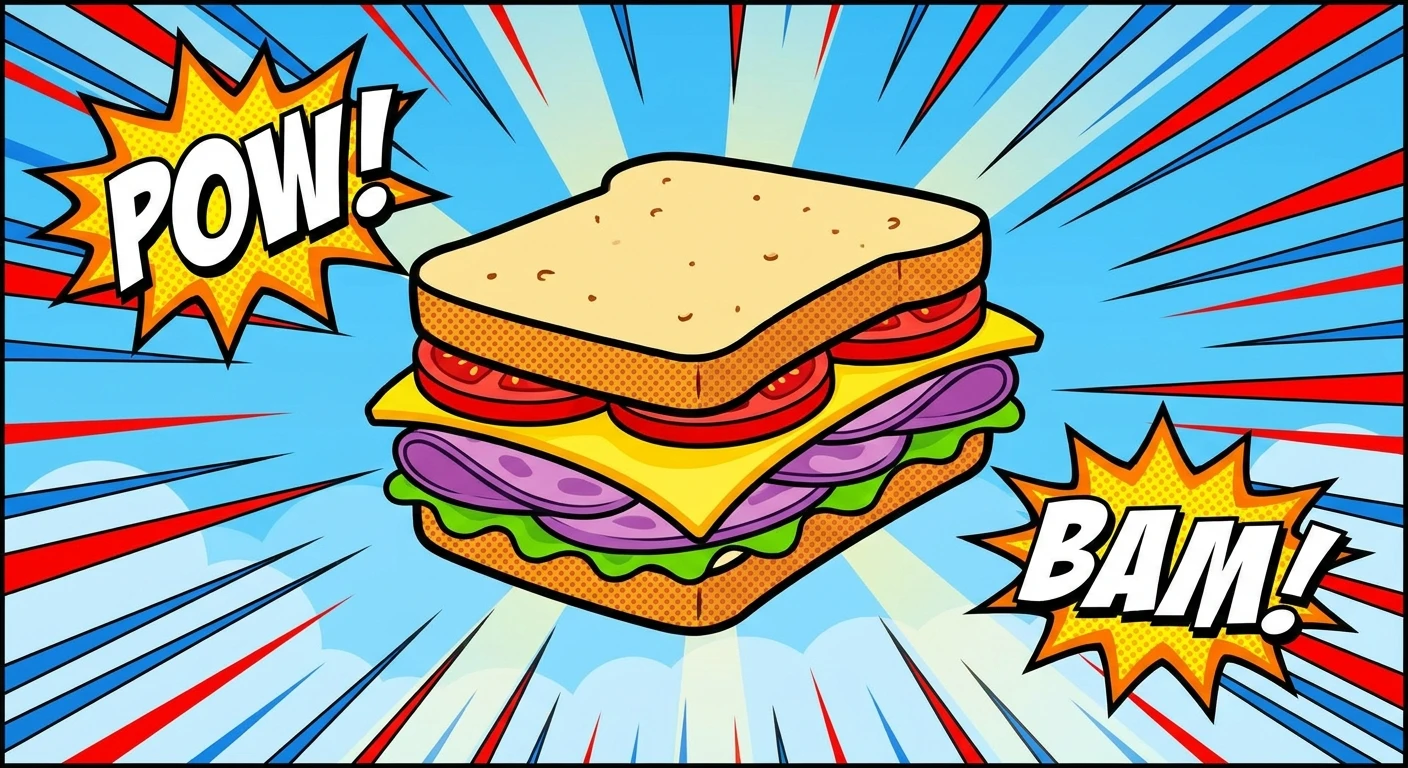
The Meaning Behind a Knuckle Sandwich
Have you ever wondered what exactly someone means when they threaten to serve up a knuckle sandwich? If you grew up watching classic Saturday morning animations, vintage mobster movies, or old-school playground disputes, you are probably highly familiar with this aggressively humorous idiom. At its core, the phrase describes a punch in the face, specifically targeting the mouth or jaw area. The brilliant absurdity of the term lies entirely in its vivid, cartoonish imagery. The attacker’s fist serves as the ‘meat’ or filling, while the recipient’s mouth acts as the unwilling consumer. We have all heard standard, boring threats in media, but pairing the comforting, domestic concept of a hearty meal with sudden blunt force trauma creates a memorable piece of slang that has effortlessly survived for generations.
Understanding how language morphs over time gives us incredible insight into human communication and pop culture. Slang is not just a random collection of words thrown together; it directly reflects the cultural attitudes, media consumption, and the collective sense of humor of a specific era. The evolution of this specific phrase offers a fantastic masterclass in how society softens violence through comedic exaggeration. Rather than delivering a raw, terrifying threat, a character offering a hearty portion of knuckles turns an otherwise hostile moment into an instant punchline. This delicate, fascinating balance between aggression and comedy is exactly why the phrase refuses to fade from our lexicon, cementing its status as an iconic piece of linguistic Americana. It is playful, slightly ridiculous, and instantly understandable, making it a perfect tool for writers, comedians, and conversationalists alike.
Read also: Captain Toad: The Ultimate Guide to the Fearless Explorer; Black Friday Shopping Guide: Strategies for the Best Deals.
Decoding the Metaphor and Its Cultural Impact
When you break down the mechanics of a knuckle sandwich, you realize it relies on a brilliant flash of cognitive dissonance. The threat promises nourishment but actually delivers pain, relying entirely on the visual metaphor of someone forcibly ‘eating’ a fist. This concept of metaphorical consumption appears constantly in English semantics, but rarely with such pinpoint comedic timing. Understanding the value of these retro idioms dramatically improves your media literacy, historical context, and creative writing skills. For instance, knowing the specific tone of mid-century slang allows screenwriters to accurately date their dialogue without sounding forced, while readers can better grasp the underlying humor in classic pulp fiction novels.
| Idiom | Literal Meaning | Pop Culture Context |
|---|---|---|
| Knuckle sandwich | A punch directly to the mouth or jaw | Classic cartoons and 1950s greaser films |
| Five square meals | Multiple punches delivered in rapid succession | Hardboiled detective novels and pulp fiction |
| Taste of leather | Being kicked in the face with a boot or shoe | Vintage Westerns and cowboy serials |
| Curtains for you | The definitive end of a situation or one’s life | Mobster cinema and noir thrillers |
Grasping the nuances of these phrases provides several distinct, tangible benefits for language enthusiasts and pop culture fans alike. Here is why studying this kind of slang actually matters:
- You can easily decode the humor and intent behind mid-20th-century literature, recognizing instantly when authors are deploying irony rather than genuine menace.
- You gain a much deeper appreciation for the comedic juxtaposition between mundane, everyday concepts like food and sudden physical violence.
- You can effectively identify the historical transition of these phrases from genuine street-level threats to harmless, sanitized retro parodies used by modern comedians.
- You develop a significantly richer vocabulary for creative writing, allowing you to craft characters who feel authentic to a specific time period without sounding overly aggressive or alienating to modern audiences.
The 1930s Origins of the Term
Language historians trace the gritty roots of the phrase back to the rough-and-tumble street culture of early 20th-century America. During the 1930s, the Great Depression fostered a hard-hitting environment where street slang flourished as a prime marker of toughness and survival. The phrase emerged organically among working-class groups and quickly found its way into the pulp magazines and hardboiled detective fiction of the era. Writers desperately needed a way for their protagonists to sound intimidating without resorting to explicit profanity, which was strictly censored at the time. A punch to the mouth seamlessly became a ‘sandwich,’ instantly communicating the threat while maintaining a level of cheeky bravado that contemporary readers adored.
Evolution Through Golden Age Television
As the decades progressed, the term underwent a massive cultural shift. By the 1950s and 1960s, it migrated entirely from the dark, rainy alleys of noir fiction into the brightly colored world of Golden Age animation and family-friendly television. Characters like Bugs Bunny, Popeye, and even live-action sitcom bullies began throwing the phrase around with reckless abandon. Because the threat was inherently absurd, network censors allowed it to pass without any issue. This era solidified the phrase as a comedic trope. The visual gag of an animated character literally preparing a sandwich out of a giant fist became a staple of slapstick comedy, forever stripping the idiom of its original, gritty menace and replacing it with pure theatricality.
The Modern State of the Idiom
Today, delivering a knuckle sandwich is almost never perceived as a genuine physical threat. Instead, it exists entirely in the realm of irony, nostalgia, and satire. When someone uses the phrase now, they are winking at the audience, intentionally evoking the ridiculous image of a 1950s greaser in a leather jacket or a cartoon villain shaking his fist in defeat. The term has even found a second life in modern interactive media, such as the surreal 2023 indie role-playing video game aptly named Knuckle Sandwich, which leans heavily into the bizarre, humorous connotations of the phrase. It stands as a fascinating monument to how words can survive long after their original context has completely vanished.
The Linguistics of Food-Based Aggression
From a purely scientific perspective, the linguistics of food-based aggression provide a fascinating study in semantic framing. When we speak, our brains naturally categorize information based on firmly established schemas. The ‘food schema’ typically activates associations with nourishment, comfort, sharing, and survival. By forcibly inserting a violent act into this comforting linguistic framework, the speaker forces the listener’s brain to reconcile two entirely conflicting concepts. This cognitive friction is exactly what makes the idiom so sticky and memorable. The brain expects a literal lunch item, but the linguistic twist replaces the expected noun with knuckles, creating an instantaneous, vivid mental image of the fist hitting the teeth. This metaphorical substitution relies on the spatial relationship between eating and being punched in the mouth, seamlessly blending the two distinct actions into a single, cohesive phrase.
Psychological Impact of Comedic Threats
Psychologists who study humor and human language suggest that hyperbolic threats serve a highly specific social function: they diffuse actual tension. When humans process extreme linguistic exaggeration, the amygdala—the brain’s primary threat-detection center—quickly recognizes the absurdity of the statement, aggressively downgrading the physical response from fear to amusement.
- Cognitive dissonance generation: The brain experiences a micro-second of confusion when pairing a domestic item with violence, which almost always results in a humor response once the metaphor is fully decoded.
- Semantic bleaching: Over decades of massive overuse in harmless media, the original aggressive intent of the phrase has been systematically erased, a linguistic phenomenon where words permanently lose their initial power and intensity.
- Metaphorical mapping: Studies in cognitive linguistics demonstrate that humans heavily rely on physical, bodily experiences to understand abstract concepts; mapping a fist onto food helps perfectly conceptualize the physical impact of a punch.
- Threat diffusion: Utilizing clearly outdated slang in a modern confrontation signals to the recipient that the aggression is performative rather than genuine, instantly lowering physiological stress markers.
Applying Retro Slang in Screenwriting
If you are currently crafting a screenplay set in the mid-20th century, utilizing era-appropriate idioms is crucial for authentic world-building. However, you must use phrases like a knuckle sandwich deliberately and carefully. Assign these colorful idioms to characters who rely on bravado, humor, and showmanship rather than actual, terrifying violence. A seasoned mob boss rarely uses playful slang when making a threat, but a street-level enforcer, a comedic sidekick, or a neighborhood schoolyard bully absolutely would. This distinct, careful linguistic choice instantly communicates the character’s maturity level, education, and social standing to the audience without requiring pages of heavy exposition.
Comparing Mid-Century Idioms
Writers and language enthusiasts should mentally map out the subtle differences between various retro threats to use them most effectively. Compare our primary phrase with telling someone to ‘put up your dukes’ or offering them ‘the one-two.’ While all three expressions involve boxing or punching, they carry entirely different flavors. Putting up one’s dukes is a formal invitation to a fair fight, whereas serving a sandwich implies a sudden, one-sided blow. Understanding these granular, subtle differences allows for sharper, more precise dialogue that accurately reflects the character’s immediate intentions and emotional state.
Recognizing Irony in Modern Dialogue
For modern speakers and actors, it is absolutely essential to recognize when a phrase has fully crossed the threshold into pure irony. If a contemporary character threatens to serve a knuckle sandwich in a modern setting, the writer is almost certainly playing the entire scene for laughs. Recognizing this massive tonal shift helps actors deliver the lines with the appropriate level of satirical swagger, and helps readers understand that the tension in the scene is artificial. Misinterpreting this idiom as serious dialogue in a modern script will completely ruin the intended comedic pacing.
Building Comedic Relief Characters
One of the absolute best practical applications of this idiom today is in the construction of comedic relief characters. Giving a character a vocabulary entirely composed of outdated, hardboiled slang immediately establishes them as hopelessly out of touch with modern reality. This specific technique works brilliantly in science fiction or modern fantasy settings, where a character might face down a highly advanced alien or terrifying monster and sincerely threaten them with a 1950s playground insult. The resulting clash of tones provides excellent, memorable, character-driven humor that audiences love.
Myths and Reality
Myth: The term originated from an actual historical incident at a New York diner where a disgruntled cook assaulted a complaining customer.
Reality: There is absolutely no historical or linguistic evidence linking the phrase to any specific restaurant dispute. It evolved purely as a clever linguistic metaphor on the streets and in pulp fiction, conceptually combining the fist with the act of eating.
Myth: People still regularly use the phrase as a genuine, intimidating threat during physical altercations.
Reality: The idiom has been completely absorbed by pop culture and modern comedy. If someone uses it today in a serious, heated conflict, they are far more likely to provoke laughter and confusion than actual fear.
Myth: The phrase was explicitly invented by the creators of Looney Tunes to easily bypass strict television censors.
Reality: While classic animation popularized the term and brought it into millions of living rooms, the phrase already existed in working-class slang and crime fiction long before iconic animated characters ever uttered it.
Myth: It refers to a hidden weapon, similar to brass knuckles, concealed inside actual food.
Reality: The phrase relies entirely on metaphorical imagery. The ‘sandwich’ is just the fist itself being delivered to the target’s mouth; it does not involve any actual literal food or concealed metallic weaponry of any kind.
What is a knuckle sandwich?
It is a classic, humorous English idiom that refers to a punch in the face, specifically targeting the jaw or mouth area of the recipient.
Who invented the phrase knuckle sandwich?
No single person is credited with its exact invention. It evolved organically in American street slang during the early 1930s before moving rapidly into mainstream media.
Is knuckle sandwich a bad word?
No, it is not considered profanity or a curse word in any context. It is a mild, somewhat cartoonish slang term used to describe physical violence.
When was knuckle sandwich most popular?
The phrase saw its absolute peak usage between the 1950s and 1970s, heavily driven by its frequent, prominent inclusion in animated television shows and comic books.
Do British people say knuckle sandwich?
While originally American in origin, the phrase is widely understood and occasionally used in the UK, largely due to the massive global export of American television and cinema.
Is there a video game called Knuckle Sandwich?
Yes, there is a well-received quirky, indie role-playing game released in 2023 that proudly shares the name, leaning heavily into the phrase’s humorous and bizarre connotations.
How do you reply to a knuckle sandwich threat?
Since the phrase is almost exclusively used as a joke or satirical callback today, the absolute best response is usually an equally ridiculous comeback or just a genuine laugh.
Does the idiom exist in other languages?
While other languages certainly have incredibly creative metaphors for a punch in the face, the specific, bizarre combination of knuckles and a sandwich is distinctively and uniquely English.
To sum it all up, the concept of a knuckle sandwich offers a truly delightful window into the way we naturally use language to defuse tension, build memorable characters, and entertain ourselves. From gritty 1930s pulp novels to modern indie video games, this phrase has proven its incredible, enduring staying power. If you loved tracing the fascinating linguistic history of this iconic piece of slang, share this comprehensive guide with your fellow language nerds and leave a comment below with your absolute favorite retro insult!





Leave a Reply