

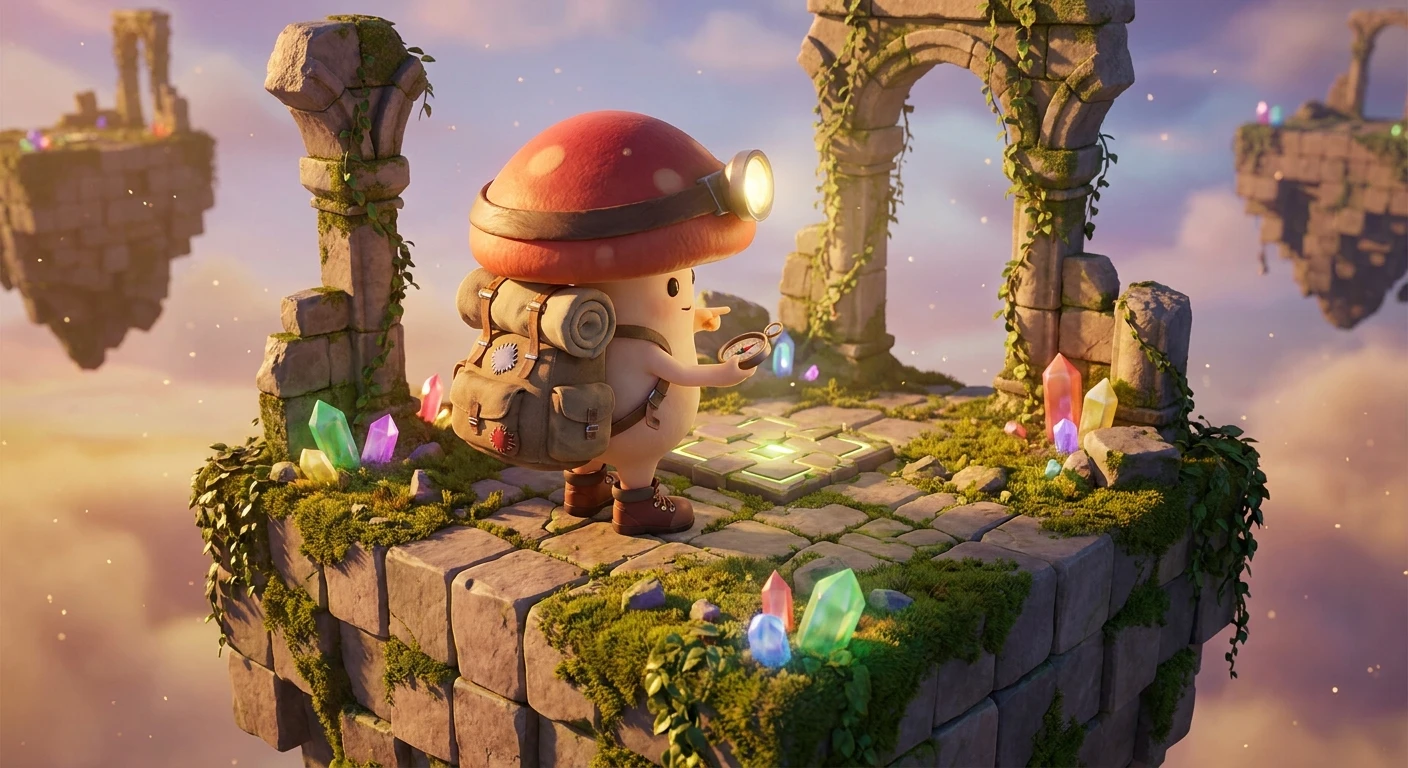
Why Captain Toad Remains a Masterpiece in Puzzle Design
Captain Toad stands out as a brilliantly crafted character and puzzle-platforming icon in the expansive Nintendo universe. When you think of traditional platformers, you usually picture high-flying jumps, rapid sprints, and mid-air acrobatics. This fearless explorer flips that entire script upside down. Burdened by an incredibly heavy backpack full of expedition gear, he completely lacks the ability to jump. That single design choice shifts the gameplay from reflex-based action to methodical, brain-teasing spatial logic. You have to navigate intricate, box-like dioramas by manipulating the camera and finding hidden pathways. The result is a deeply satisfying, entirely unique rhythm that forces you to perceive space differently.
Every single level feels like a beautifully crafted toy box. The developers meticulously designed these miniature worlds to ensure that every visual cue, every enemy placement, and every moving block serves a specific mechanical purpose. You get a direct, spontaneous connection to the environment because you are constantly rotating the perspective to see what hides behind a wall or beneath a bridge. The charming aesthetics, coupled with the character’s unwavering bravery in the face of giant dragons and spooky ghosts, create an experience that resonates with both casual players and hardcore completionists. Understanding how this specific mechanic changes the way you interact with digital environments is the key to mastering his adventures.
Read also: Top kirby nintendo switch Games to Play Now; Top Mario Nintendo Switch Games to Play Today.
Exploring the core mechanics requires understanding exactly how the lack of a jump button affects your survival strategies. Since you cannot leap over obstacles or stomp on enemies, you must rely entirely on environmental tools, gravity, and timing. This creates a brilliant dynamic where patience and observation outrank fast reflexes. You are constantly assessing risks, planning routes, and waiting for the perfect window to slip past a patrolling Shy Guy. The gameplay loop centers heavily on finding and collecting Power Stars and Super Gems, which are often locked behind clever optical illusions or multi-step logic puzzles.
The tools at your disposal are simple but incredibly effective when used correctly. The design provides distinct mechanics that compensate for the heavy backpack. Here is a breakdown of the primary tools you use to survive:
| Mechanic | Primary Function | Strategic Application |
|---|---|---|
| Heavy Backpack | Prevents jumping entirely | Forces players to use ladders, slopes, and controlled drops to navigate vertical spaces. |
| Plucked Turnips | Ranged projectile defense | Pull these from the ground and throw them at enemies or distant switches to clear paths. |
| Super Pickax | Temporary invincibility | Use this power-up to rapidly smash through blocks and defeat groups of enemies in seconds. |
To truly excel at these diorama puzzles, you need to adopt a specific mindset. The value of this gameplay lies in its cerebral approach, which offers several distinct advantages over traditional action games. For example, it is highly accessible for players who struggle with complex button combos, yet it offers a massive challenge for those trying to beat target times. To succeed consistently, follow these core principles:
- Master the camera controls: Never move forward without rotating the camera 360 degrees to check for hidden alcoves or ambush points.
- Understand enemy patrol routes: Enemies operate on strict loops. Observe their patterns and plan your movements to pass behind them safely.
- Utilize environmental hazards: Use moving blocks, trapdoors, and enemy friendly-fire to clear obstacles that you cannot handle directly.
The Humble Origins of the Toad Brigade
The journey of this intrepid character began long before he received his own dedicated title. His initial debut took place in the critically acclaimed Super Mario Galaxy in 2007. Here, he was introduced as the leader of the Toad Brigade, a group of bumbling but well-meaning explorers assisting Mario across the cosmos. Sporting his signature headlamp and an oversized backpack, he provided comic relief, helpful hints, and the occasional Power Star. The developers created him specifically to give the Toad species more personality and distinct roles within the expansive universe, establishing a narrative foundation for a character who loved adventure but lacked the athletic prowess of his famous peers.
The Evolution into a Standalone Star
The real turning point occurred in 2013 with Super Mario 3D World. The developers decided to experiment with a mini-game format that removed the jump mechanic entirely. These isolated puzzle stages required players to guide the character through small, isometric levels to collect Green Stars. The reception to these brief interludes was overwhelmingly positive. Players loved the drastic change of pace and the clever, diorama-style level design. Nintendo recognized the massive potential of this concept and rapidly expanded it, giving the character his own full-length game, Captain Toad: Treasure Tracker, released in 2014. This transition from a supporting NPC to a leading protagonist proved that strong level design could carry a game even without traditional platforming abilities.
The Modern State of the Franchise
Today, the franchise occupies a beloved niche within the larger corporate catalog. The original game was successfully ported to modern consoles, introducing new levels based on Super Mario Odyssey and adding cooperative multiplayer modes. The character now frequently appears in various spin-offs, party titles, and merchandise lines. He serves as an ambassador for thoughtful, accessible puzzle-solving. The ongoing popularity of his specific style of gameplay proves that there is a permanent, high-demand market for slower, more cerebral experiences that rely on charm, spatial reasoning, and meticulous design rather than high-speed action sequences.
Diorama Level Design Architecture
The architectural philosophy behind these levels is rooted in the Japanese concept of hakoniwa, which translates directly to “box garden.” This design framework dictates that the entire playable area is confined within a visually distinct, self-contained cubic space. The engineering challenge involves packing an immense amount of interactivity into a very small footprint. Designers use forced perspective, overlapping vertical planes, and hollow interiors to create a dense labyrinth within a tiny volume. The architecture relies on seamless transitions between the exterior shell of the level and its hidden interior corridors, requiring a highly optimized rendering pipeline to manage occlusion culling—the process where the game stops rendering objects that are blocked by walls to save processing power.
Camera Mathematics and Player Perspective
The entire game engine is built around complex camera mathematics. Because the player’s primary tool is perspective manipulation, the camera logic must be flawless to prevent clipping through geometry or disorienting the player. The system employs both orthographic and perspective projection techniques to ensure that distances and angles remain readable. Understanding the technical mechanics reveals a fascinating layer of design:
- The camera pivot point is dynamically locked to the character’s exact coordinates, ensuring smooth spherical rotation around the center of action.
- Collision detection algorithms calculate ray-casts from the camera lens to the player, automatically making exterior walls transparent when they obstruct the view.
- State-machine AI logic governs the enemies, triggering specific aggression states only when the player enters their defined line-of-sight cones.
- Touchscreen and gyroscope inputs are mathematically translated into precise cursor coordinates, allowing players to freeze enemies or manipulate blocks interactively.
Step 1: Analyze the Entire Board Before Moving
Do not touch the movement controls the moment a level begins. The very first action you must take is rotating the camera completely around the floating island. Look at the structure from the top down, and then lower the angle to check beneath ledges and water surfaces. Identifying your final destination and spotting the locations of all three Super Gems immediately gives you a mental roadmap. This initial pause prevents you from blindly walking into a corner or accidentally dropping off a ledge that you cannot climb back up.
Step 2: Track Down Every Super Gem
Every stage contains three hidden Super Gems. Treating these as optional is a mistake, as collecting them unlocks later progression gates. Plan your route to intercept these gems naturally. Some are hidden inside invisible blocks, while others require you to defeat a specific enemy or throw a turnip at a distant switch. If you reach the final Power Star without all three gems, do not grab the star; retrace your steps and thoroughly inspect any areas you might have bypassed.
Step 3: Master the Turnip Throwing Arc
Pluckable turnips are your primary offensive weapon. They do not fly in a straight line; they follow a distinct parabolic arc based on gravity. Spend time practicing this trajectory. You need to accurately predict where the turnip will land to hit moving targets or trigger switches across wide gaps. Remember that you can carry a turnip with you, so always keep one equipped when walking into uncharted, potentially dangerous territory.
Step 4: Outsmart the Shy Guys Without Combat
Direct confrontation is rarely the optimal strategy. Shy Guys are predictable; they walk in set patterns and only chase you if they see you directly. You can use the environment to break their line of sight. Duck behind blocks, wait for them to turn around, and simply walk past them. If you drop onto their heads from a higher ledge, you will defeat them without needing a weapon, saving you time and preserving any items you might be carrying.
Step 5: Search for the Elusive Pixel Toad
Once you complete a level, you unlock a secondary objective to find a retro, 8-bit sprite hidden somewhere in the environment. This sprite does not move, but it is often blended perfectly into the background textures or hidden behind interactive elements. Tap every suspicious wall, spin every wheel, and look closely at posters or background scenery. Finding this sprite trains your eyes to notice minute environmental details that you previously overlooked.
Step 6: Memorize the Timed Maze Patterns
Some of the most difficult challenges involve blocks that appear and disappear on a strict timer, often synchronized to the background music. You cannot rush these sections. Stand in a safe zone and count the beats. Memorize the exact sequence of the shifting platforms. Once you understand the rhythm, you can execute a flawless sequence of movements. Hesitation is what causes failure on these timed paths, so commit to your route once you step forward.
Step 7: Conquer the Mummy-Me Chase Levels
The ultimate test of your skills comes in the form of a relentless, terrifying mummy doppelganger that mimics your exact movements on a slight delay. You cannot defeat this enemy; you can only outrun it. The trick here is never to backtrack or pause. You must carve a continuous, forward-moving path through the maze. Use circular routes to kite the enemy away from narrow corridors, ensuring you always have an open exit strategy as you make your way to the final objective.
Myth: Captain Toad is just a regular Toad character who happens to be wearing a headlamp for visual flair.
Reality: He is the officially recognized leader of the Toad Brigade, possessing a distinct identity, unique voice clips, and a specific narrative history that separates him from the generic citizens of the Mushroom Kingdom.
Myth: The puzzle levels are inherently too easy and offer no real challenge for experienced veteran gamers.
Reality: While completing the basic story path is highly accessible, achieving 100% completion by finding every gem, beating all target times, and clearing the brutal Mummy-Me mazes requires exceptional spatial reasoning and flawless timing.
Myth: You are completely defenseless because the heavy backpack prevents you from jumping on enemies.
Reality: You have multiple offensive options, including throwing plucked turnips, utilizing the invincible Super Pickax, luring enemies into environmental traps, and dropping onto foes from elevated platforms.
Myth: The camera perspective is purely an aesthetic choice to make the game look like a cute diorama.
Reality: The manipulative camera is an active gameplay mechanic; moving it is absolutely mandatory to solve spatial puzzles, reveal hidden doors, and progress through the geometry.
Can Captain Toad jump?
No, his signature heavy backpack is filled with so much expedition gear that he is entirely incapable of leaving the ground, making traditional platforming impossible.
What was his very first game appearance?
He made his official debut in the 2007 classic Super Mario Galaxy, where he was introduced as the brave but clumsy leader of the Toad Brigade.
Does he appear as a playable racer in Mario Kart?
While standard Toads have always been staples of the kart racing roster, his specific explorer persona was prominently featured as a distinct playable driver in Mario Kart Tour.
Who is Toadette in the context of this game?
She is a fellow fearless explorer and the game’s co-star. She shares the exact same mechanics, and the narrative frequently switches between the two characters as they rescue each other.
What does the term Hakoniwa mean?
It is a Japanese term translating to “box garden,” which perfectly describes the game’s philosophy of designing dense, self-contained, miniature puzzle boxes.
Is the main adventure multiplayer?
While originally a strictly single-player experience, the modern ports on current hardware introduced a full two-player cooperative mode, allowing friends to solve the puzzles together.
What is the Pixel Toad challenge?
It is an intense hide-and-seek mini-game unlocked after beating a level, tasking the player with finding a tiny, flattened retro sprite hidden somewhere in the 3D environment.
Why does he collect Super Gems?
Super Gems serve as the primary collectible currency that proves your mastery of a level; accumulating them is required to unlock the gates to later chapters and boss fights.
The brilliant design of these hakoniwa puzzles guarantees an experience unlike anything else on the market. By actively stripping away the most fundamental verb in platforming history—the jump—the developers created a masterpiece of level architecture, spatial reasoning, and pure charm. Whether you are rotating the camera to find a hidden Super Gem, mapping out the safest route past a sleeping dragon, or sprinting away from a terrifying Mummy-Me, the mechanics always remain tight, fair, and incredibly rewarding. If you have never experienced the joy of this unique puzzlebox adventure, grab your headlamp, pack your heaviest backpack, and start your incredible treasure-hunting journey today!





Leave a Reply