

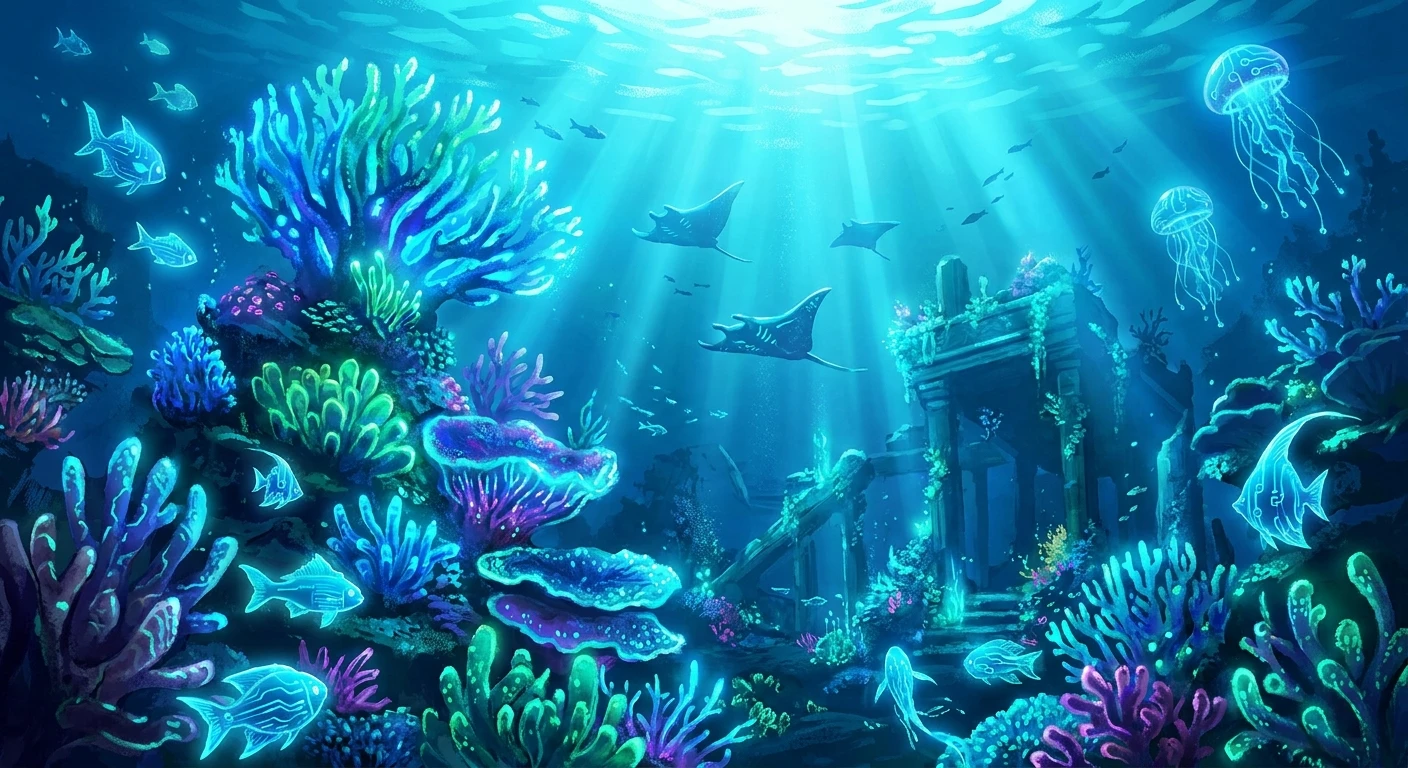
Why endless ocean luminous Is The Ultimate Virtual Escape
Listen, if you are looking for a genuine break from the absolute chaos of daily life, endless ocean luminous is exactly the digital retreat you have been waiting for. I was just thinking about this yesterday while sitting in my favorite crowded coffee shop near Zoloti Vorota in Kyiv. The espresso machine was hissing, sirens were wailing in the distance, and the general hum of city life was reaching a fever pitch. I booted up my console, slipped on my headphones, and suddenly, I was floating through a serene, glowing coral reef. It completely wiped away my stress. That is the magic we are talking about here. You do not just play it; you inhabit it. It acts as a digital anchor, keeping you grounded when everything else feels overwhelming.
Now that we are deep into 2026, the gaming landscape is utterly saturated with high-stress, competitive shooters and massive role-playing games that demand hundreds of hours of grinding. We genuinely need titles that ask nothing of us except to exist, observe, and breathe. My main argument here is simple: this aquatic adventure redefines how we interact with virtual spaces, proving that exploration and passive observation can be just as compelling as combat and high-stakes action. You are not fighting for survival; you are merely cataloging beauty.
The Core Mechanics: Why You Will Love The Deep Blue
Okay, I completely understand if you are skeptical. Floating around and scanning virtual fish sounds a bit tedious on paper, right? But the execution is brilliant. The core loop revolves around scanning marine life, uncovering mysteries of the Veiled Sea, and collaborating with others. It hooks your brain’s natural desire for completion and discovery without ever punishing you for failing. The progression system feels totally organic.
| Gameplay Feature | Solo Experience | Multiplayer Experience |
|---|---|---|
| Exploration | Meditative, paced completely by you. | Dynamic, fast-paced map clearing. |
| Marine Scanning | Focus on reading biological lore. | Race to tag rare species for the group. |
| UML Discovery | Takes significant time and patience. | Shared coordinates make it a team effort. |
The value proposition here is massive. First, you get an unparalleled relaxation tool. Second, you are getting an interactive aquarium that genuinely teaches you about marine biology. For example, finding a rare Coelacanth tucked away in a dark cave provides a massive hit of dopamine. Another example is coordinating with twenty-nine other strangers to uncover a massive mythological creature just by using non-verbal pings. It is incredible.
- Mental Health Benefits: The ambient soundtrack and rhythmic breathing sound effects literally lower your heart rate.
- Educational Value: The sheer volume of scientifically accurate data on real-world species is staggering.
- Low-Friction Socializing: You can play with dozens of people without ever hearing a toxic voice chat.
The Origins of the Franchise
To really appreciate what we have now, we need to talk about where this all started. The franchise originally launched back on the Nintendo Wii. It was a completely different era of gaming. Developers were experimenting with motion controls, and the idea of just pointing a remote at the screen to interact with a dolphin was revolutionary at the time. Arika, the studio behind the magic, recognized early on that there was an untapped market for non-violent, exploration-heavy experiences. Those early games built a cult following, mostly through word of mouth among gamers who wanted something to play after a long, exhausting workday.
Evolution Across Hardware Generations
Moving from the Wii era to the current generation was a massive leap. Back in the day, we were dealing with standard definition textures and very limited draw distances. You would swim into a cloudy blue fog pretty quickly. Today, the hardware allows for complex lighting engines. When you swim through a kelp forest now, the rays of sunlight actively pierce through the canopy, dynamically shifting as the water surface ripples above. The transition from motion controls to traditional dual-stick navigation also made the experience vastly more accessible and precise.
The Modern State of Virtual Diving
The implementation of large-scale multiplayer in the modern era fundamentally changed the dynamic. Instead of diving with just an AI partner or one friend, dropping into a lobby with up to thirty players creates a sense of shared awe. As of 2026, the procedural generation ensures that no two dive sites are ever exactly the same. The community has established entire online databases dedicated to sharing specific dive seeds, turning the game into a massive crowdsourced oceanography project. It is fascinating to watch players organize themselves entirely through in-game mechanics.
Procedural Generation Mechanics Explained
Let us talk tech for a second because the engine running the Veiled Sea is genuinely impressive. Unlike previous titles that featured meticulously hand-crafted maps, this system uses procedural generation based on complex algorithms. Think of it like a massive deck of cards, where each card is a different biome, topography piece, or temperature zone. The engine shuffles this deck every single time you start a new dive, ensuring a fresh layout. It calculates the depth, light penetration, and environmental hazards to seamlessly stitch these tiles together so it never feels artificial.
Marine Biology Accuracy in Pixels
The developers did not just slap a fish texture on a moving polygon; they integrated actual behavioral algorithms. The artificial intelligence dictating how these creatures move is based on real-world fluid dynamics and biological research. Predators will naturally patrol specific zones, while schooling fish use complex collision-avoidance programming to move as a singular, fluid entity. When you approach them, their reaction time mimics their real-world counterparts.
- Light Penetration Physics: Colors actively fade from the spectrum as you descend, with reds disappearing first, perfectly mimicking real oceanic optics.
- Algorithmic Schooling Behaviors: Small fish utilize boids algorithms to flock dynamically without clipping into one another.
- Bioluminescence Triggers: Deep-sea creatures only illuminate when approached or when interacting with specific environmental stimuli.
- Biome Transition Matrices: Temperature gradients subtly shift the visual filters, indicating a change from warm shallow waters to abyssal zones.
Day 1: Mastering the Basic Controls
Your first day is all about getting comfortable in the water. Do not rush. Spend your time in the shallow tutorial areas. Get used to the buoyancy controls and the turning radius of your diver. Practice scanning every single common fish you see. The goal here is to build muscle memory so that accessing your scanner and marking waypoints becomes second nature before you hit the deeper, darker waters.
Day 2: Mapping Your First Veiled Sea
Once you are comfortable, initiate your first solo dive into the procedurally generated Veiled Sea. Pick a direction and stick to it. I highly recommend swimming the perimeter of the map first to establish the boundaries. Use your map constantly. Drop markers on anything that looks like a point of interest, even if you cannot fully explore it yet. Mapping out the grid is incredibly satisfying and sets you up for success later.
Day 3: Deep Sea Light Mechanics
Now it is time to plunge into the abyss. As you descend past the photic zone, your surroundings will turn pitch black. You will need to rely entirely on your diver’s artificial lights and the natural bioluminescence of the deep-sea creatures. Pay close attention to your surroundings, as navigating without natural sunlight requires you to use the topography to maintain your sense of direction. Scan everything glowing; they are usually rare variants.
Day 4: Multiplayer Synchronization
It is time to hop online. Join a shared dive with other players. The objective here is not to talk, but to follow the silent cues of the group. When a player pings a location, swim toward it. Share your own findings by pinging rare fish or hidden caves. You will quickly notice how efficient a group of thirty people can be when clearing the fog of war from the map. It is cooperative mapping at its finest.
Day 5: Hunting for Unidentified Marine Life (UML)
UMLs are the massive, legendary creatures hidden in specific conditions. On day five, dedicate your time to fulfilling the specific in-game requirements to summon one. Usually, this involves scanning a set number of glowing anomalies scattered across the map. Once the anomalies are collected, the environment shifts, the music changes, and you get to witness a truly spectacular, larger-than-life mythical beast. It is pure cinematic joy.
Day 6: Salvaging Rare Artifacts
Beyond the biological wonders, the ocean floor is littered with sunken treasures and ancient artifacts. Dedicate today to sweeping the seabed. Look for unnatural geometric shapes buried in the sand or hidden inside shipwrecks. Collecting these artifacts not only levels up your profile but also provides fascinating little lore snippets about fictional ancient civilizations that once sailed these waters.
Day 7: Achieving 100% Scan Rates
Your final day of the core plan is about meticulous cleanup. Open your logbook and identify exactly which species you are missing. Read their habitat descriptions and filter the map to find the specific biomes they spawn in. This requires patience. Sometimes a creature only appears during a specific time cycle or at a highly specific depth. Getting that 100% completion badge is insanely rewarding.
Debunking Ocean Exploration Myths
Myth: The map is completely infinite.
Reality: While the name implies endlessness, the actual playable area for each dive is a mathematically generated square grid. It is massive, but it does have definite boundaries you will eventually hit.
Myth: You have to manage oxygen and survive attacks.
Reality: There are zero survival mechanics. You never run out of air, and even the most aggressive-looking Great White Sharks will simply swim past you. It is entirely a stress-free zone.
Myth: The multiplayer lobbies are chaotic and overwhelming.
Reality: Because there is no voice chat and interaction is limited to pings and emotes, the multiplayer is surprisingly zen. It feels more like swimming alongside friendly ghosts than playing a frantic online game.
Myth: The graphics are vastly outdated compared to other modern titles.
Reality: While it might not push photorealism, the art direction, fluid dynamics, and atmospheric lighting make it one of the most visually cohesive and beautiful aquatic games available.
How long is the main story mode?
The structured narrative portion is actually quite brief, taking roughly ten to fifteen hours. However, the true meat of the experience lies in the endless procedural dives and completing the massive encylopedia.
Do I absolutely need an online subscription?
You can play the solo mode perfectly fine entirely offline. But to access the massive thirty-player shared dives, which is a huge part of the fun, an active online subscription is required.
Are there any microtransactions?
No. You unlock different wetsuit colors, emotes, and stickers purely by playing, discovering artifacts, and leveling up your diver rank through scanning.
How many species are actually in the game?
There are over five hundred distinct species of marine life to discover, ranging from tiny freshwater fish to massive prehistoric leviathans.
Can you customize your diver?
Yes, you can extensively change the color palette of your suit, your diving tanks, and equip various cosmetic stickers you find on the ocean floor to express your personal style.
Is it compatible with VR headsets?
Currently, it is strictly a flat-screen experience on the console. While VR would be amazing, the third-person camera perspective was chosen to prevent motion sickness during deep-sea navigation.
Can I play completely peacefully?
Yes, the entire premise is one hundred percent peaceful. There is no combat, no failing, and absolutely no way to die. It is pure, unadulterated exploration.
Look, if you need to lower your blood pressure, grab your console, boot up the game, and just float for a while. Share your most beautiful underwater screenshots with the community, and I guarantee you will feel better. See you in the deep!





Leave a Reply